Operator Grid / How much to charge for office cleaning
How much to charge for office cleaning: price it per visit, week and month
Most office clients want one flat price per month. The way to get that number right is to work out the labor hours for one visit, multiply by how often you clean, add your other costs and keep the margin you need.
There is no single correct price for cleaning an office, and any national "average" will be wrong for your area, your wages and your crew's speed. What you can get right is the method. This guide shows how cleaning businesses charge for office work, the formula to build a monthly price, a worked example at four weekly frequencies, and how to check your number per hour and per square foot.
How cleaning businesses charge for office cleaning
Flat monthly price. The usual choice for regular office accounts. The client gets one predictable invoice, and you build it from hours per visit and visits per month.
Price per visit. Common for small offices cleaned once or twice a week, and for one-time or occasional cleans. It's the same math as the monthly price, just billed by the visit.
Hourly rate. Simple, but office managers usually prefer a fixed price they can budget. Keep an hourly target behind the scenes even when you quote flat prices.
Price per square foot. Often quoted for larger commercial buildings. Treat it as a result of your hours and costs, not a number you pick first. See commercial cleaning production rates for how square footage turns into hours.
The office cleaning pricing formula
Cost per visit = (labor hours per visit × loaded labor cost per hour) + supplies + travel + overhead share
Price per visit = cost per visit ÷ (1 − target profit margin)
Monthly price = price per visit × visits per month
Visits per month = visits per week × 52 ÷ 12. Twice a week is about 8.67 visits a month, not 8, so pricing on four weeks a month underprices every account by roughly 8%.
"Loaded" labor cost means the wage plus payroll taxes, workers' comp and any other cost you pay for each hour worked. Dividing by (1 − margin) keeps a true margin; a 40% markup on cost gives only a 28.6% margin.
How to estimate the hours for an office
- Walk the space before you quote. Note square footage by area type, the number of restrooms and fixtures, the kitchen or break room, floor types and trash points.
- Write the scope by area and frequency. Trash, dusting, vacuuming, mopping and restroom sanitizing each visit; periodic work like carpet extraction, floor care and interior glass priced separately.
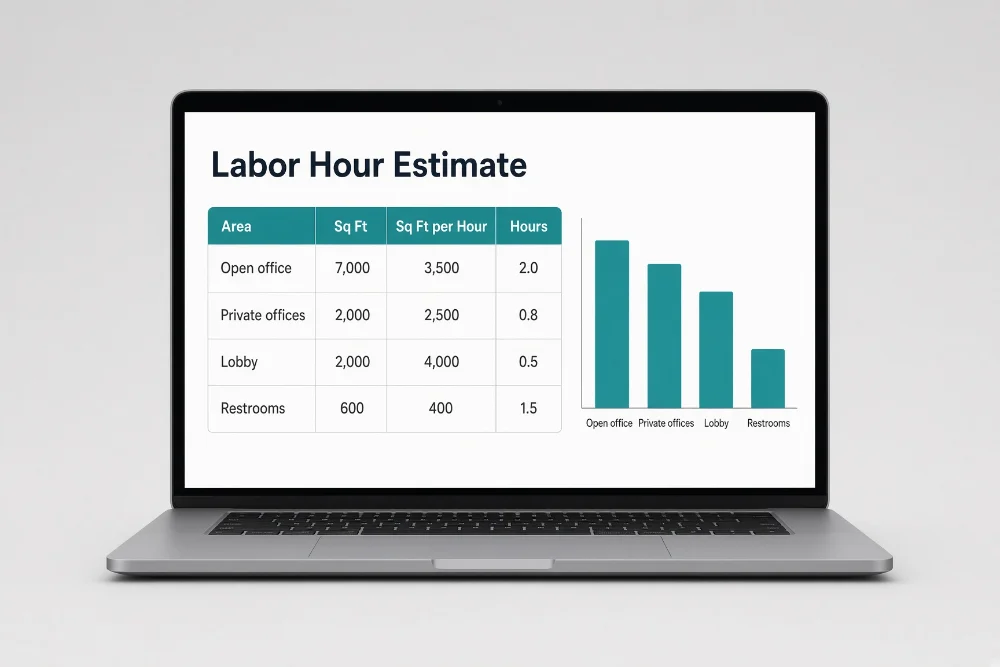
- Convert area to hours. Divide each area's square footage by your production rate for that kind of space, then add 10% or so for setup, supply-closet trips and lockup.
- Check after the first month. Compare actual hours with quoted hours and fix your rate sheet before the next bid.
Worked example: one small office at four weekly frequencies
All figures below are sample numbers to show the method. They are not market rates or recommended prices.
A 3,000 sq ft office with two restrooms and a small break room takes 1.5 labor hours per visit. Sample costs: $22.00 an hour loaded labor, $4.00 supplies, $6.00 travel and a $10.00 overhead share per visit, with a 40% target margin.
Cost per visit = 1.5 × $22.00 + $4.00 + $6.00 + $10.00 = $53.00. Price per visit = $53.00 ÷ 0.60 = $88.33.
| Frequency | Visits per month | Price per visit | Weekly price | Monthly price | Per sq ft per month |
|---|---|---|---|---|---|
| Once a week | 4.33 | $88.33 | $88 | $383 | $0.13 |
| Twice a week | 8.67 | $88.33 | $177 | $766 | $0.26 |
| 3 times a week | 13.00 | $88.33 | $265 | $1,148 | $0.38 |
| 5 nights a week | 21.67 | $88.33 | $442 | $1,914 | $0.64 |
The price per visit stays the same because every visit in this example takes the same time. In practice, offices cleaned every night often take a little less time per visit than offices cleaned once a week, because less dirt builds up between visits. Time a few visits at the frequency you are quoting and adjust the hours, not the margin.
How much to charge per hour for office cleaning
Even when you quote a flat price, you need an hourly target to see whether the price pays:
Target price per labor hour = (loaded labor cost per hour + other costs per labor hour) ÷ (1 − target profit margin)
In the example, the $20.00 of other costs per visit spread over 1.5 hours is about $13.33 an hour. ($22.00 + $13.33) ÷ 0.60 ≈ $58.89 per labor hour. If a monthly price you are about to send works out well below your target per hour, either the hours are too low or the price is.
Price per square foot: use it as a check
Divide the monthly price by the square footage to get a per-square-foot number you can compare with other bids. In the example, twice a week comes to about $0.26 per sq ft per month. If your number is far above or below what local clients are used to, look at your hours, scope and costs first. A competitor's per-square-foot price tells you nothing about their wages, their scope or whether they are making money.
What to put in an office cleaning quote
- The scope by area and how often each task happens
- Periodic work priced as separate lines: carpet cleaning, floor care, interior windows
- Who supplies paper goods, soap and trash liners
- Cleaning days and times, keys and alarm procedures
- The monthly price, payment terms, and how and when prices are reviewed
- How long the quote is valid
Send it as a written estimate with the free cleaning estimate and bid template, then put the ongoing terms in writing with a commercial cleaning contract template before you start.
Common office cleaning pricing mistakes
- Pricing on four weeks a month. A month averages 4.33 weeks; the difference is unpaid work every month.
- Forgetting travel on small offices. A short visit with a long drive can cost more in travel than in supplies.
- Bundling periodic work into the visit price. Carpet and floor care need their own hours and their own line items.
- Copying a competitor's price. You don't know their costs, scope or margin.
- Never reviewing the price. Wages and supplies go up every year; put a price review in the agreement.
Common questions
How much should I charge for office cleaning a week?
Work out the price per visit from your hours and costs, then multiply by visits per week. In this guide's sample (1.5 labor hours per visit, $22 an hour loaded labor, $20 of other costs per visit and a 40% margin), each visit is about $88.33, so twice a week is about $177 a week. Your number will change with your wages, costs, speed and area.
How much do office cleaners charge per hour?
Rates vary widely by area, so build your own target: loaded labor cost per hour plus supplies, travel and overhead per hour, divided by one minus your target margin. With the sample numbers here that is about $58.89 per labor hour. Most offices still expect a flat monthly price rather than an hourly bill.
Should I charge per square foot for office cleaning?
Use price per square foot as a comparison number, not the starting point. Two offices with the same square footage can need very different hours because of restrooms, kitchens, floor types and clutter. Price from hours first, then divide by square footage to see how you compare.
How do I price a one-time office clean?
Time or estimate the hours for the specific job, add supplies, travel and overhead, and price it per visit at your target margin. One-time and first cleans usually take longer than regular visits, so don't quote them at your recurring per-visit price.
How do I raise prices for office cleaning clients?
Put a price review in the agreement, give written notice before the change, and explain which costs went up. Small yearly increases are usually easier for clients to accept than one large jump after several years.
More guides
- Commercial cleaning production rates
- Commercial cleaning contract template
- Free cleaning estimate and bid template
- Cleaning quote calculator
- How much to charge for house cleaning
- Free cleaning invoice template
- Cleaning Business AI Growth OS: everything included
Example figures in this guide are illustrative only. Check prices against your local market before you quote. Results vary; no specific revenue or profit is guaranteed.