Operator Grid / How much to charge for house cleaning
How much to charge for house cleaning: a pricing method that pays
Copying a competitor's price or guessing an hourly rate is how cleaning businesses end up busy and broke. Pick a pricing method, cover every cost, then check the result against your market.
There is no single correct price for a house cleaning, and any national "average" will be wrong for your area, your costs and your speed. What you can get right is the method. Here are the four common ways cleaners price jobs, what each is good for, and how to pick a number you can defend.
The four ways cleaners price jobs
1. Flat rate per visit
One price for the whole clean. This is the most common approach for residential work because clients know the cost up front. Behind the scenes, you still need an hourly target so you can tell whether each flat price actually pays.
2. Hourly rate
Simple to set up and fair for jobs you cannot size in advance, such as heavy deep cleans. The downside: clients cannot predict the total, and faster cleaners earn less for being efficient.
3. Per square foot
Common for move-out, post-construction and commercial cleaning, where the area is known. It is quick to quote but misses things that drive time, like the number of bathrooms or the condition of the home. For office accounts, see how much to charge for office cleaning.
4. Per room
A price for each bedroom, bathroom, kitchen and living area. It's easy for clients to understand and works well on a website price list. Bathrooms and kitchens usually take the most time, so price them higher. A house cleaning price sheet puts your per-room and per-home rates on one page.
What your price has to cover
Whichever method you use, the number has to pay for all of this, not just the cleaner's wage:
- Labor: hours × cleaners × your full hourly cost, including payroll taxes or your own pay.
- Supplies used on the job.
- Travel: fuel and drive time between jobs.
- Overhead: insurance, software, phone, marketing and admin time, shared across your jobs.
- Profit: the margin you keep after every cost is paid.
Quote = (labor + supplies + travel + overhead share) ÷ (1 − target profit margin)
Run your numbers in the free quote calculator
How to adjust the price
- Deep cleans and move-outs take longer than a standard clean of the same home. Time a few real jobs of each type and price from those speeds.
- Recurring discounts: weekly and every-two-weeks homes are faster to clean after the first visit, which is why many cleaners charge less per visit for them. Only discount what the time savings actually cover.
- Add-ons: inside ovens, fridges, cabinets, interior windows, baseboards and laundry are best priced as separate line items.
- Pets, clutter and condition: build in extra time or a separate charge rather than absorbing it.
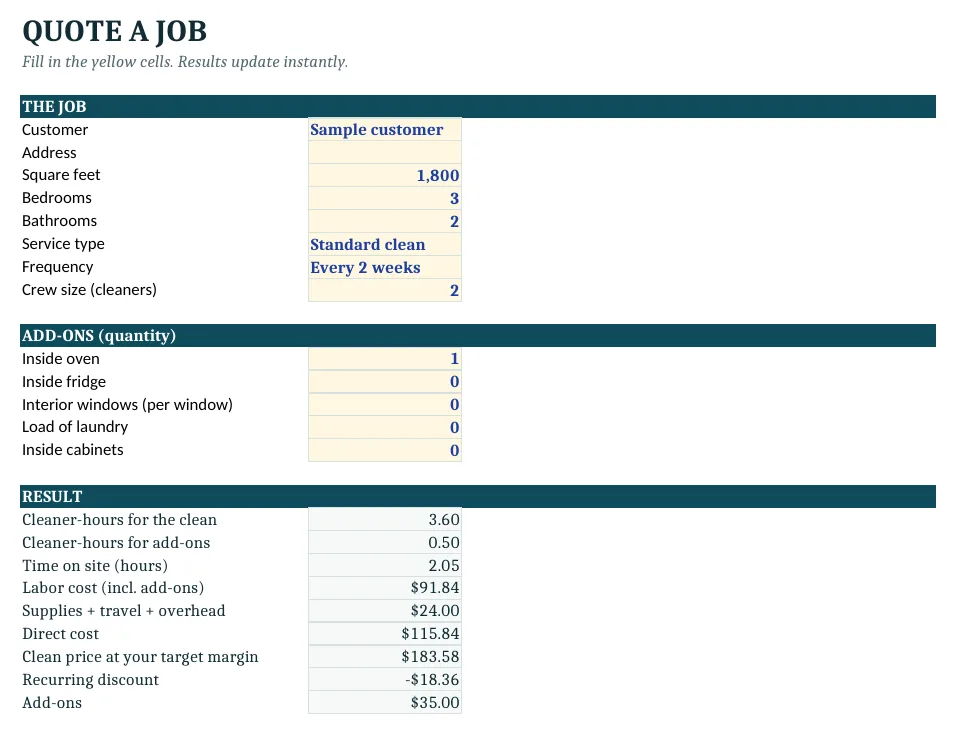
Worked examples: pricing four common jobs
These examples run the formula above with the same sample costs: $22 per cleaner-hour of labor (wage plus payroll costs), a $10 overhead share per visit and a 40% target margin. Hours, supplies and travel change by job. They show the method, not market prices, so swap in your own costs and timed jobs.
| Job | Cleaner-hours | Labor ($22/hr) | Supplies | Travel | Overhead | Job cost | Quote at 40% margin |
|---|---|---|---|---|---|---|---|
| Standard clean, 2-bed / 1-bath | 3 | $66 | $8 | $6 | $10 | $90 | $150 |
| Deep clean, same home | 5.5 | $121 | $14 | $6 | $10 | $151 | $252 |
| Move-out clean, empty 3-bed / 2-bath | 7 | $154 | $18 | $6 | $10 | $188 | $313 |
| Every-two-weeks recurring, 2-bed / 1-bath | 2.5 | $55 | $7 | $6 | $10 | $78 | $130 |
The recurring visit costs the client less only because it takes less time. The margin on every job is still 40%. That is the difference between a recurring discount that pays and one that quietly eats your profit.
How much to charge per hour for house cleaning
Even if you quote flat prices, you need an hourly target to know whether each price pays. Work it out backwards from your costs:
Target rate per cleaner-hour = (hourly labor cost + overhead, supplies and travel per hour) ÷ (1 − target profit margin)
Example: $22 of labor plus about $5 per hour of overhead, supplies and travel is $27 of cost per cleaner-hour. At a 40% margin the target is $27 ÷ 0.60 = $45 per cleaner-hour. A $150 flat quote on a job that takes one cleaner 3 hours earns $50 per hour, so it clears the target. The same $150 on a job that runs 4 hours earns $37.50 per hour, so that job is underpriced.
Then compare with your market. If local flat prices imply a much lower hourly rate than your target, the cause is usually one of three things: your costs are higher, your team is slower, or competitors are underpricing. Each one has a different fix, so find out which before you cut your price.
Put the price in writing
Once you have the number, send it as a written estimate, confirm the scope and terms in a service agreement, and bill against it with a clear invoice. Start with the free cleaning estimate and bid template and the free cleaning invoice template. The Growth OS includes a cleaning service agreement, a proposal and an invoice among its 15 client-form templates.
Check your price against the market, then check it against your results
Before sending a quote, look at what local competitors list on their websites. Then track every quote you send and whether it closes. If nearly every quote is accepted, you are probably too cheap. If almost none are, look at your price or how you present it. Comparing actual hours with quoted hours after each job shows which prices are really profitable.
Common questions
How much should I charge to clean a house?
Build the price from your own costs: estimated cleaner-hours times your labor rate, plus supplies, travel and an overhead share, divided by one minus your target margin. Then compare it with local prices. There is no single correct national price.
Is it better to charge hourly or a flat rate for house cleaning?
Most residential cleaners quote a flat rate per visit and keep an hourly target behind the scenes. Hourly pricing suits jobs that are hard to size in advance, like heavy deep cleans.
How do I price a deep clean or move-out clean?
Time a few real deep and move-out cleans and price from those speeds. They take longer than a standard clean of the same home, so the same formula gives a higher price.
Should recurring clients get a discount?
Many cleaners charge less per visit for weekly or every-two-weeks clients because the home stays cleaner and each visit is faster. Keep the discount within the time you actually save.
How much should I charge per hour to clean houses?
Work out a target from your own costs: hourly labor cost plus overhead, supplies and travel per hour, divided by one minus your target margin. With $27 of cost per cleaner-hour and a 40% margin, the target is $45 per cleaner-hour. Your number will differ with your wages, costs and area.
How much should I charge for a first-time clean?
A first clean usually takes longer than later visits because of built-up dirt, so many cleaners price it closer to a deep clean or quote it separately, then move the client to the regular recurring price. Time the first visit so you can price the recurring visits accurately.
How do I raise prices for existing clients?
Give recurring clients written notice ahead of the change, explain that your costs have gone up, and apply the new price from a set date. Small yearly increases are usually easier for clients to accept than one large jump after several years.
More guides
- House cleaning price sheet and sample rate card
- Free cleaning invoice template
- Free cleaning estimate and bid template
- Cleaning quote calculator
- Cleaning business CRM template and lead tracker
- Cleaning business software without a monthly fee
- Cleaning Business AI Growth OS: everything included
- Cleaning service contract template
- How much to charge for office cleaning