Operator Grid / Cleaning service contract template / Commercial
Commercial cleaning contract template: the clauses a janitorial agreement needs
A commercial cleaning contract, also called a commercial cleaning agreement or janitorial contract, sets out what you clean in a business property, how often, for what price, and for how long. Commercial accounts are larger and longer than residential ones, so the agreement needs more detail. These are the clauses to include, with sample wording you can adapt.
This page is general information, not legal advice. Contract rules vary by state and country, so have a local attorney review your agreement before you use it.
How a commercial cleaning agreement differs from a residential one
A house cleaning agreement can be one or two pages with a simple notice period. A commercial cleaning contract usually adds a cleaning schedule broken down by area, a fixed term that renews, insurance requirements, after-hours access and security rules, and confidentiality. It may also name a site contact on the client's side and set how complaints are logged and fixed. If you clean homes too, start with the residential cleaning service contract template.
The 12 clauses to include in a commercial cleaning contract
- Parties, site and site contact. Your business name, the client's legal business name, every address covered, and the person on the client's side who approves work and receives reports.
Sample wording: “This agreement is between [Your Business] (“Contractor”) and [Client Legal Name] (“Client”) for janitorial services at [Site Address(es)]. Client's site contact is [Name, Title, Phone].” - Scope of work by area. List each area (offices, restrooms, break rooms, lobbies, floors) and the tasks in each. Attach the schedule as an exhibit so it can be updated without rewriting the contract.
Sample wording: “Contractor will perform the tasks listed in Exhibit A, Cleaning Specifications, at the frequencies shown. Work outside Exhibit A is billed separately at the rates in Exhibit B.” - Frequency and service hours. Days per week, start and finish times, and whether work happens before opening, after close or during business hours.
Sample wording: “Services will be performed [number] nights per week, [days], between [time] and [time]. Holiday closures listed in Exhibit C are excluded.” - Price and billing. A monthly flat rate is the most common structure for recurring commercial work. State what is included, the rate for extra or one-time work, and when invoices are issued.
Sample wording: “Client will pay $[amount] per month for the services in Exhibit A. Contractor will invoice on the [day] of each month for that month's services.” - Payment terms and late payment. Commercial clients often pay on net terms, such as net 15 or net 30. Say what happens when payments are late. Late fees are regulated in some places, so check local rules.
Sample wording: “Invoices are due within [number] days. Contractor may suspend service if any invoice remains unpaid [number] days after its due date.” - Term and renewal. The start date, the length of the agreement, and whether it renews automatically.
Sample wording: “This agreement begins on [date] and runs for [12] months. It renews for successive [12]-month terms unless either party gives written notice at least [30] days before the end of the current term.” - Price adjustments. How the price can change at renewal or when the scope, square footage or frequency changes. This protects you when wages and supply costs rise during a long contract.
Sample wording: “Contractor may adjust pricing at renewal with at least [number] days' written notice. Changes to scope, square footage or frequency will be priced by written change order.” - Supplies, equipment and consumables. Who provides cleaning products and equipment, and who buys restroom consumables such as paper towels, toilet paper, soap and liners. Leaving this out is a common source of surprise costs.
Sample wording: “Contractor provides cleaning chemicals and equipment. Client provides restroom and break-room consumables, which Contractor will restock from Client's supply.” - Access, keys, alarms and security. How the crew gets in after hours, who holds keys, cards and alarm codes, sign-in rules, and what happens if the crew is locked out or an alarm goes off.
Sample wording: “Client will issue [number] keys or access cards and alarm codes. Contractor will keep a key log, follow Client's security procedures, and return all keys and cards within [number] days of termination.” - Insurance, staff and confidentiality. The insurance you carry, whether a certificate of insurance is required, how staff are screened or supervised if the client asks, and a promise not to disclose what the crew sees.
Sample wording: “Contractor carries general liability insurance of $[amount] per occurrence and will provide a certificate of insurance on request. Contractor's staff will not remove, copy or disclose Client's documents or information.” - Quality checks and complaints. How the client reports a missed task, how fast you respond, and any regular walkthroughs. A clear fix process protects the account better than refunds.
Sample wording: “Client will report missed tasks to Contractor within [number] hours. Contractor will correct them by the next scheduled service. The parties will hold a walkthrough every [month/quarter].” - Termination and signatures. How either side can end the contract early, for cause or with notice, and what is owed on termination. End with signature, title and date lines for someone authorized to sign for each business.
Sample wording: “Either party may terminate this agreement with [30] days' written notice. Client will pay for all services performed through the termination date. Signed: ____________ Name/Title ____________ Date ______”
Sample cleaning specification for an office
Most commercial cleaning contracts attach a specification like this as Exhibit A. Adjust the tasks and frequencies to the site you walked and the price you quoted.
| Area | Tasks | Typical frequency |
|---|---|---|
| Restrooms | Clean and disinfect toilets, urinals, sinks and counters; restock consumables; empty trash; mop floors | Each service |
| Offices and workstations | Empty trash and recycling; dust reachable surfaces; vacuum carpets; spot-clean glass | Each service |
| Break room or kitchen | Wipe counters, tables and sink; clean microwave exterior; empty trash; mop floor | Each service |
| Entrance and lobby | Clean entry glass; vacuum mats; dust and wipe reception area | Each service |
| Hard floors | Machine scrub or burnish | Monthly or quarterly |
| Carpets | Deep extraction | Quarterly or as quoted |
| High dusting | Vents, ledges and light fixtures | Monthly |
Example only. Frequencies vary by building type, foot traffic and what the client is willing to pay.
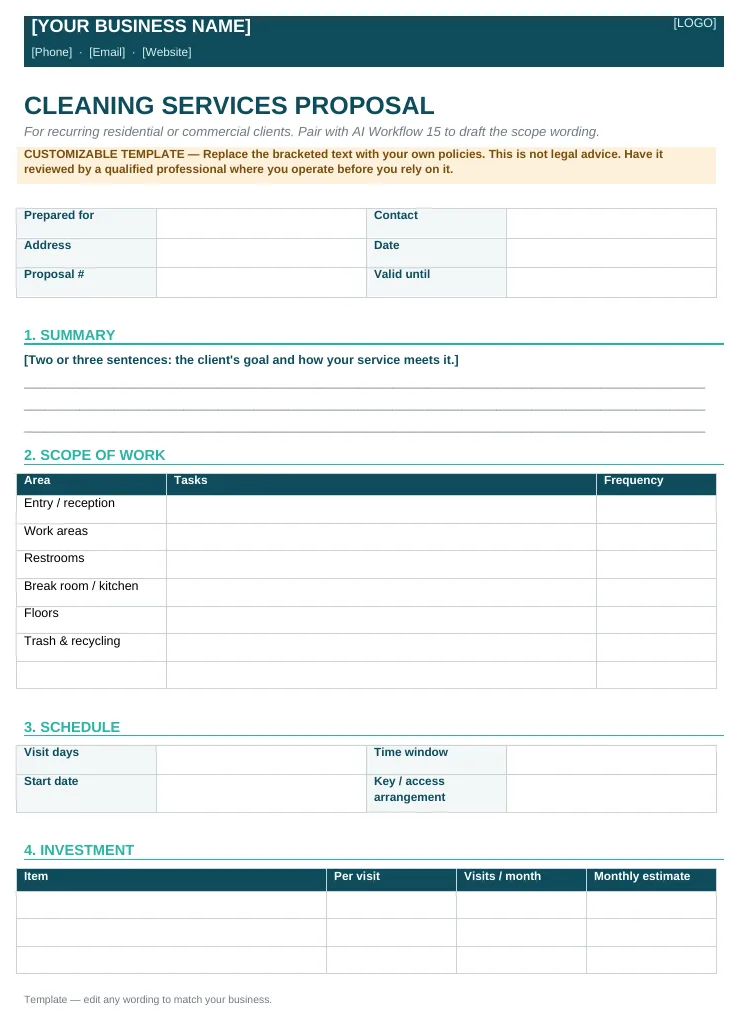
Before you sign a commercial account
- Walk the site first. Measure the square footage, count restrooms and fixtures, and note floor types. Price from the walkthrough, not a phone call.
- Send a written bid with the specification. The estimate and the agreement should describe the same scope. Our cleaning estimate and bid template covers the bid.
- Check the client's insurance and vendor requirements. Some property managers have their own vendor agreement and will ask you to sign theirs instead. Read it for indemnity, insurance limits and payment terms before you agree.
- Price for the full term. A 12-month contract at a price that barely covers today's wages loses money later. Use a price adjustment clause and know your cost per visit; the cleaning quote calculator helps.
Common questions
What is the difference between a commercial cleaning agreement and a janitorial contract?
In practice they mean the same thing: a written agreement to clean a business property on a schedule. Janitorial contract is more common for ongoing nightly or daily office and facility work; commercial cleaning agreement is the broader term. Both should cover scope by area, frequency, price, term, insurance, access and termination.
How long should a commercial cleaning contract be?
Many commercial cleaning contracts run for a fixed term, often 12 months, and renew automatically unless either side gives written notice. A shorter trial period, such as 90 days, can help win a new account. Whatever term you choose, state the notice period for ending it.
Should a commercial cleaning contract include a price increase clause?
Yes. Wages, supplies and fuel costs change, so a fixed-term contract should say whether and how the price can change at renewal and how much written notice you will give. Without one, you may be locked into an unprofitable price for the full term.
Do commercial clients require proof of insurance?
Many do. Commercial clients and property managers commonly ask for a certificate of insurance before work starts, and some ask to be named on it. Check the client's requirements before you sign and list the coverage you carry in the agreement.
More guides
- Commercial cleaning production rates
- Cleaning service contract template (residential)
- Free cleaning estimate and bid template
- Free cleaning invoice template
- Cleaning quote calculator
- Cleaning business CRM template and lead tracker
- Cleaning Business AI Growth OS: everything included
- How much to charge for office cleaning