Operator Grid / Commercial cleaning / Production rates
Commercial Cleaning Production Rates: How to Measure Yours and Bid With Them
A commercial cleaning production rate is how much area (usually square feet) one worker can clean in one hour for a given type of space and scope. You divide each area's square footage by its production rate to get labor hours, then multiply hours by your loaded labor cost and add supplies, overhead and profit to get your bid price. The most reliable rates are the ones you time on your own jobs, with published benchmarks used only as a starting check.
If you have ever won a commercial account and then realized your crew needs two more hours a night than you priced, the problem was almost always the production rate. This guide shows you how to build a simple rate sheet, how to use it in a bid, and the mistakes that quietly eat your margin.
What a production rate is (and isn't)
A production rate turns "how big is this building?" into "how many labor hours will this take?" It is usually written as square feet per labor hour, but some tasks are easier to measure per unit (minutes per restroom fixture, per trash can, per desk).
The Building Service Contractors Association International (BSCAI) describes two useful types in its January 2025 Inside Cleaning article by David Murphy:
- Task-specific rates – the time for one task, such as emptying a trash can or cleaning one toilet.
- Comprehensive rates – the total time to clean a whole facility of a certain type, size, layout and scope, expressed as one square-feet-per-hour number.
That same article notes that labor accounts for 50–80% of janitorial service costs, which is why a small error in your rate turns into a large error in your price.
What a production rate is not: it is not a price per square foot. Two buildings can have the same square footage and very different hours, because a 10,000 sq ft warehouse office and a 10,000 sq ft medical clinic have completely different restroom counts, floor types, and cleanliness expectations.
Why your own rates beat a generic chart
Industry references exist. ISSA publishes The Official ISSA Cleaning Times, and APPA publishes cleaning standards widely used for schools and public facilities. They are worth consulting as a sanity check. But your real rate depends on things a chart can't see:
- Your crew's experience and how many people work together
- Your equipment (backpack vacuum vs. upright, microfiber system vs. string mop)
- Clutter and furniture density in the space
- The scope the client actually expects (a "quick tidy" vs. detailed dusting)
- Building layout: one open floor vs. many small rooms, stairs, elevators
Use published numbers to check you are in a reasonable range. Use your own timed numbers to price.
How to measure your own production rates in 5 steps
- Pick one area type at a time. Open office, private offices, restrooms, break room, lobby and hallways are a good starting list.
- Measure the area. Get square footage from a floor plan, the client, or a laser measure. For restrooms, also count fixtures (toilets, urinals, sinks).
- Define the scope in writing. List exactly what "cleaned" means for that area (trash, dust surfaces, vacuum, mop, sanitize touchpoints). A rate is only meaningful for a specific scope.
- Time it over several visits. Record start and stop times for each area across at least three to five cleans. Early visits run slow while the crew learns the building, so watch the trend, not just the first night.
- Calculate the rate. Square feet ÷ hours = square feet per hour. Write it on your rate sheet with the date, building type and scope notes.
A simple production rate sheet
Keep one row per area type. The numbers below are placeholders for illustration only — replace them with your own timed results.
| Area type | Scope notes | Your rate (sq ft / labor hr) | Times measured | Last updated |
|---|---|---|---|---|
| Open office | Trash, dust desks, vacuum carpet | Example: 3,500 | 5 | — |
| Private offices | Trash, dust, vacuum, more doors and furniture | Example: 2,500 | 4 | — |
| Lobby & hallways | Vacuum or dust mop, glass doors, touchpoints | Example: 4,000 | 5 | — |
| Break room | Counters, sink, appliance exteriors, mop | Example: 1,000 | 3 | — |
| Restrooms | Sanitize fixtures, restock, mop | Example: 400 | 5 | — |
Worked example: turning rates into a bid
All figures below are example numbers to show the math. They are not industry benchmarks or recommended prices.
An office client has a 12,000 sq ft space and wants cleaning 5 nights per week.
Step 1: Hours per visit
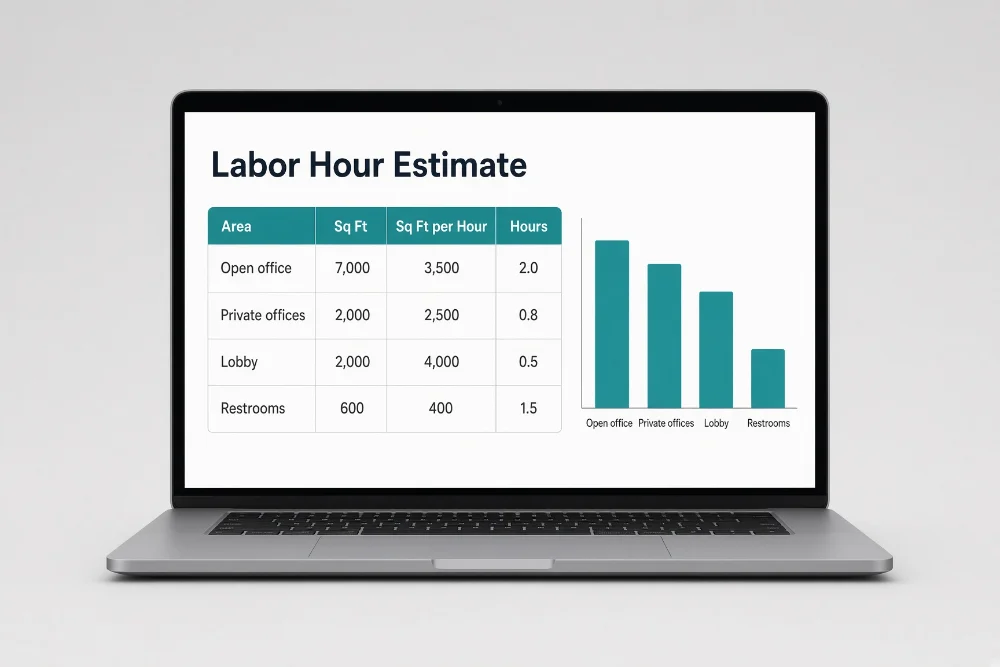
| Area | Sq ft | Example rate (sq ft/hr) | Hours |
|---|---|---|---|
| Open office | 7,000 | 3,500 | 2.0 |
| Private offices | 2,000 | 2,500 | 0.8 |
| Lobby & hallways | 2,000 | 4,000 | 0.5 |
| Break room | 400 | 1,000 | 0.4 |
| Restrooms (4) | 600 | 400 | 1.5 |
| Subtotal | 12,000 | 5.2 |
Add a buffer for setup, closet trips and lockup. In this example we add 10%: 5.2 × 1.10 = 5.72 hours, rounded to 5.7 labor hours per night. That gives a comprehensive rate for this building of about 12,000 ÷ 5.7 ≈ 2,105 sq ft per hour.
Step 2: Hours per month
5 nights × 52 weeks ÷ 12 months ≈ 21.67 visits per month.
21.67 × 5.7 hours ≈ 123.5 labor hours per month.
Step 3: Direct cost
- Example loaded labor cost (wage + payroll taxes + workers' comp + other per-hour costs): $22.00/hour
- Labor: 123.5 × $22.00 = $2,717
- Example supplies and consumables allowance: $150/month
- Direct cost: $2,867/month
Step 4: Price for your target margin
If you want direct costs to be 60% of the price (a 40% gross margin that has to cover overhead and profit), divide by 0.60:
$2,867 ÷ 0.60 ≈ $4,778 per month, or about $0.40 per sq ft per month for this example building.
Pricing a smaller office that you clean once to three times a week? See how much to charge for office cleaning for weekly and monthly examples.
Notice the per-square-foot number came last. It is an output of your hours and costs, not something you pick first and hope works.
Common production-rate mistakes
- Using one rate for the whole building. Restrooms and break rooms take far longer per square foot than open carpet. Blend them and you'll underprice fixture-heavy buildings.
- Timing only your best worker. Price with the pace your typical crew member can keep up night after night.
- Forgetting non-cleaning time. Unlocking, alarm codes, filling buckets, hauling trash to a dumpster and walking between floors all cost labor.
- Mixing daily and periodic work. Carpet extraction, floor stripping and high dusting need their own rates and their own line items. Don't bury them in the nightly rate.
- Never updating. After the first month on a new account, compare actual hours to bid hours. If they differ, fix the rate sheet before your next bid.
- Pricing from a competitor's per-square-foot number. You don't know their labor cost, scope, or whether they're losing money.
Pre-bid walkthrough checklist
- ☐ Total square footage, broken down by area type
- ☐ Restroom count and fixture count
- ☐ Floor types (carpet, VCT, tile, sealed concrete)
- ☐ Number of trash and recycling points
- ☐ Cleaning frequency for each area (nightly, weekly, monthly)
- ☐ Periodic work requested (floor care, windows, carpet extraction)
- ☐ Access hours, alarm and key procedures
- ☐ Who supplies paper goods and soap
- ☐ Special requirements (medical waste rules, secure areas, green products)
- ☐ Photos of problem areas to reference when estimating time
Frequently asked questions
What is a production rate in commercial cleaning?
It's the amount of area, usually in square feet, that one worker can clean in one labor hour for a defined scope and type of space. You use it to convert square footage into labor hours when you bid.
What is a good production rate for office cleaning?
There is no single right number. It depends on the space, scope, equipment and crew. Use references like the ISSA Cleaning Times as a sanity check, then rely on rates you've timed in buildings like the one you're bidding.
How do I calculate labor hours from square footage?
Divide each area's square footage by its production rate, add the results, then add a buffer for setup and non-cleaning time. For example (example numbers only), 7,000 sq ft at 3,500 sq ft per hour is 2 labor hours.
Should I bid commercial cleaning by the hour or by square foot?
Most commercial clients expect a flat monthly price. Build that price from labor hours and costs first; the price per square foot is a useful comparison number, but it should be the result of your math, not the starting point.
How do I handle floor stripping, carpet cleaning and other periodic work?
Give each periodic task its own production rate and frequency, then price it as a separate line item or a separate monthly allowance. Mixing it into the nightly rate hides its cost.
How often should I update my production rates?
Review them after the first month on every new account and whenever you change equipment, crew size or scope. Compare actual hours to bid hours and adjust.
Related guides
- Free cleaning estimate and bid template
- Commercial cleaning contract template
- Cleaning quote calculator
- Cleaning Business AI Growth OS: everything included
- How much to charge for office cleaning
Source: David Murphy, "Commercial Cleaning Production Rates: A Key to Successful Bidding and Estimating," BSCAI Inside Cleaning, January 22, 2025. Example figures in this article are illustrative only. Results vary; no specific revenue or profit is guaranteed.